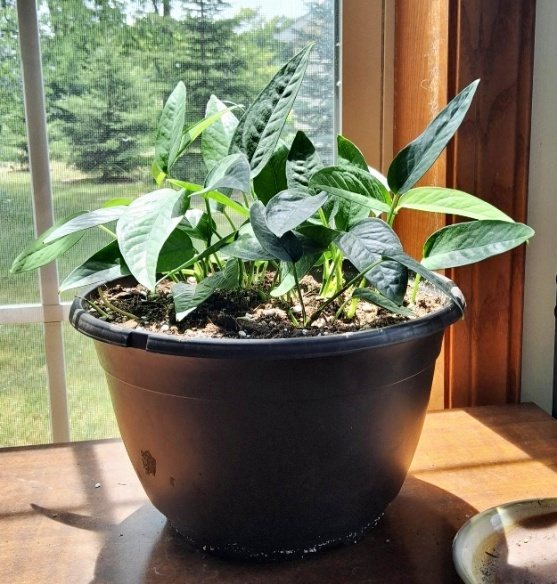
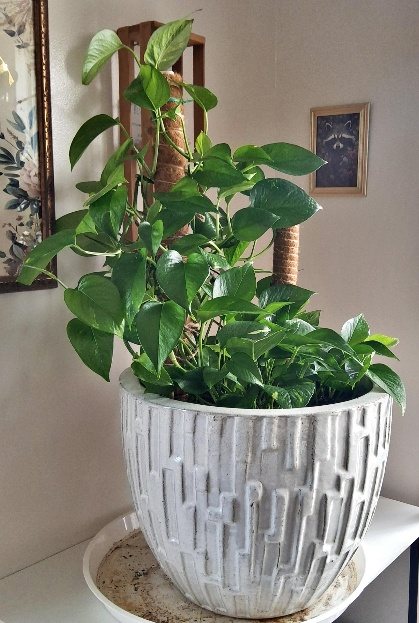
 Verified collection photograph
Plant Guide
Golden Pothos
Epipremnum aureum
Other known names: Devil's ivy · Pothos aureus · Scindapsus aureus · Rhaphidophora aurea
A durable climbing vine with yellow-and-green foliage. It tolerates ordinary rooms, but stronger filtered light generally supports denser growth and clearer variegation.
Published source-backed guide. This guide meets Lorekeeper's published source, care-completeness, safety, and identity checks. It is source-backed, not an expert-review claim.
Toxic. Contains insoluble calcium oxalates; keep away from pets and children who may chew it.
Care
- Light
- Medium to bright indirect light; acclimated plants tolerate some gentle sun.
- Water
- Observe the root ball and water after the upper layer has dried; do not keep the pot continuously saturated.
- Growing medium
- An airy container mix with reliable drainage.
- Feeding
- Feed only while the plant is actively growing; start below the label rate.
- Temperature
- 65-85 F; protect from cold drafts.
- Humidity
- Average household humidity is acceptable.
- When to consider watering
- Use observed moisture and pot weight, not a fixed weekday.
- Watering method
- Feel below the surface, water the entire root ball, and let excess drain. If the mix is still wet, postpone and record the observation.
- Repotting
- Repot when roots repeatedly fill the pot or the medium has broken down, usually only one pot size larger.
- Pruning
- Trim above a node to shape the vine and encourage branching.
- Beginner note
- Low light and a large pot can keep the mix wet for much longer. A reminder should prompt a check, not force watering.
Observe the plant and growing medium before acting. A reminder is a prompt to check, not an automatic instruction to water.
Characteristics
A durable climbing vine with yellow-and-green foliage. It tolerates ordinary rooms, but stronger filtered light generally supports denser growth and clearer variegation.
Names & botanical identity
- Accepted name
- Epipremnum aureum
- Plant family
- Araceae
- Plant group
- Pothos
- Other known names
- Devil's ivy · Pothos aureus · Scindapsus aureus · Rhaphidophora aurea
- Safety
- Toxic
Contains insoluble calcium oxalates; keep away from pets and children who may chew it.
Growth
- Growth habit
- A climbing or trailing evergreen aroid.
- Mature size
- 6–10 ft vines indoors with support or trailing
- Native range
- Native to the Society Islands; widely cultivated and naturalized elsewhere.
- Temperature
- 65-85 F; protect from cold drafts.
- Humidity
- Average household humidity is acceptable.
- Difficulty
- Beginner
Propagation
Cut below a node, remove the lowest leaf, and keep the node in water or lightly moist medium.
When you add a propagation to Lorekeeper, connect it to the mother plant so its history and lineage remain intact.
Problems to recognize
These links describe possible or look-alike relationships, not a diagnosis. Start with visible evidence and rule out alternatives.
- Excess moisture / root stress: A continuously wet root zone can stress container-grown pothos; confirm moisture and roots.
- Root rot syndrome: Root rot is a possible consequence of damaged roots and persistently wet conditions; inspect roots.
- Mealybugs: Nodes and leaf joints provide hiding places; confirm living insects.
- Thrips: New foliage can be damaged by thrips; confirm insects or characteristic scarring.
History & lineage
Golden pothos became a familiar household vine through the international foliage-plant trade. Its accepted identity is Epipremnum aureum, while several older and commercial names remain common.
Add this guide to My Plants to preserve acquisition notes, parent plants, propagations, photographs, and future name changes in one living record.
Keep the useful part
Save Golden Pothos to your garden.
Carry this guide into a private plant record, then add your own photographs, care, journal entries, and lineage over time.
Keep exploring